

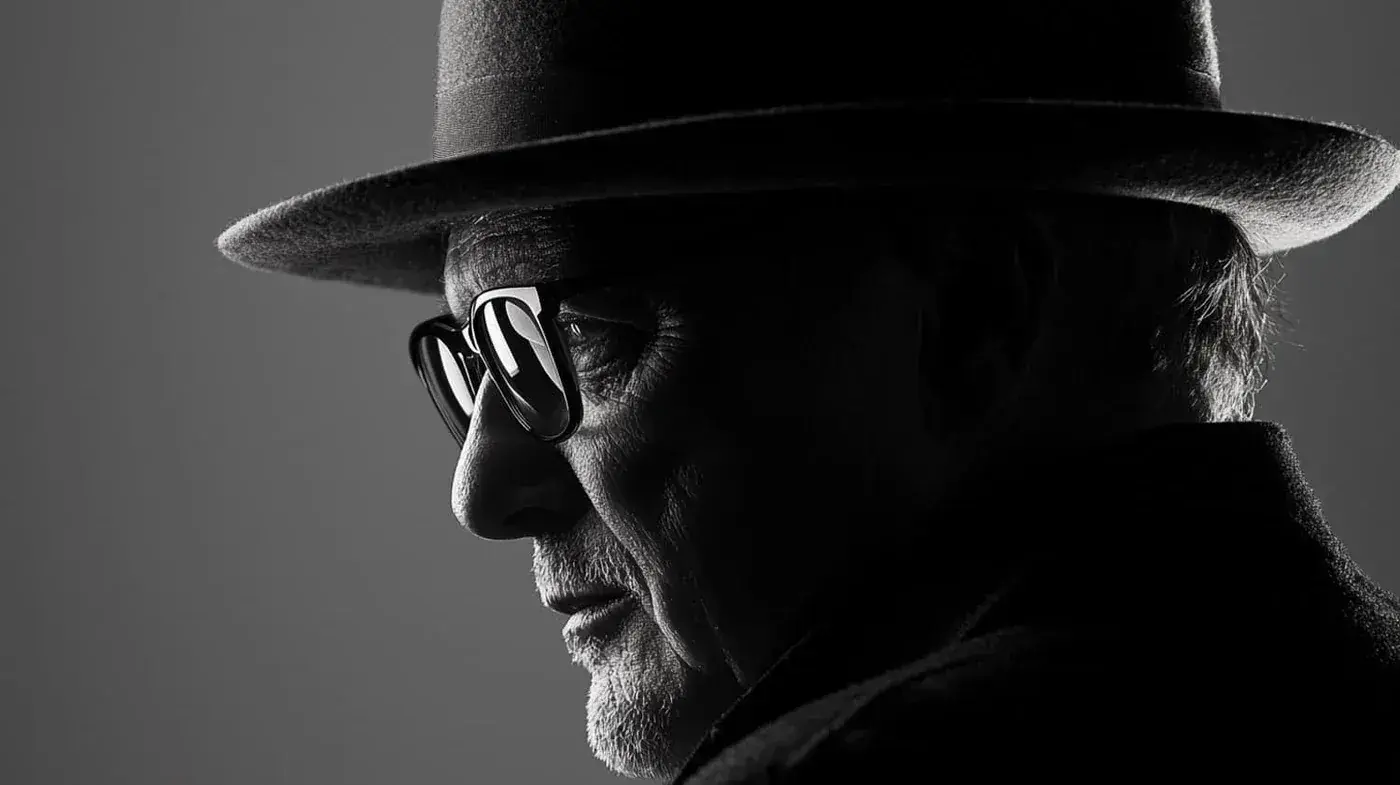
Table of content
1. The eye of an artist, the mind of a scientist, and the heart of a journalist2. Ed Koch, 1989
3. The controversial Bush portrait, 1990
4. Rudolph Giuliani, 2001
5. Luis Sarria, 1987
6. Mick Jagger and Tina Turner, 1985
7. Michael Phelps, 2005
8. Jodie Foster, 1991
9. Senator John Glenn, 1998
10. George W. Bush, 1995
11. Bruce Springsteen, 2002
12. Denzel Washington
13. Mike Ditka and Ricky Williams, 2005
14. David Lynch, 1990
15. Hillary Clinton, 1992
16. The role of education and legacy
- November 20, 2025 at 9:58 PM
-
5.2K
-
1 comment
Rudolph Giuliani: a narrative of tragedy and chromatic atmosphere
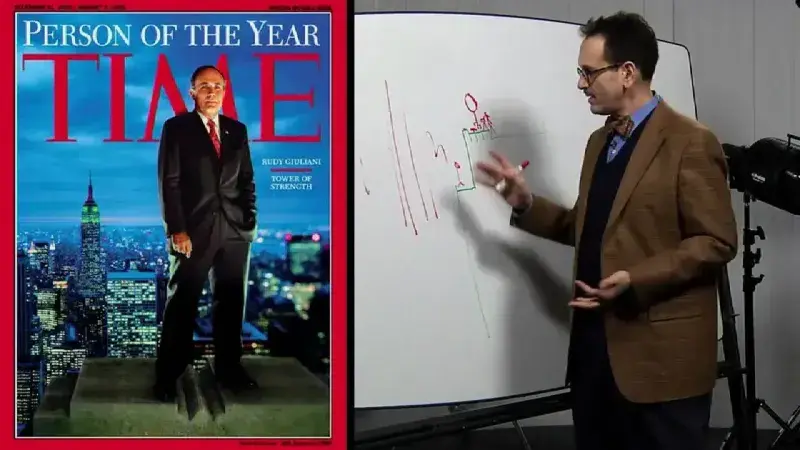
The portrait of Rudolph Giuliani created by Gregory Heisler for the cover of TIME magazine in late 2001 stands as one of the most powerful and emotionally charged images in modern photojournalism to address the aftermath of the September 11 terrorist attacks. Chosen for the Person of the Year series, the photograph demonstrates how Heisler deploys his technical arsenal — the “mind of a scientist” — not in the service of aesthetic beauty, but to convey the oppressive, almost suffocating (noxious) psychological state of the city.
Context: a visual chronicle of catastrophe
The shoot took place amid an unimaginable crisis. Heisler, whose studio was located roughly a mile north of Ground Zero, personally witnessed the collapse of the World Trade Center towers. He later recalled that Lower Manhattan remained saturated for weeks with the smell and the palpable sense of grief.
Editorial task: Heisler was charged with creating “something” with Mayor Giuliani that would speak both about the man himself and about the crisis of 9/11. The portrait was intended to serve as a visual anchor for a historic moment.
The primary goal, described as the “hero shot,” was to depict the mayor standing “above New York with the ruins of the World Trade Center behind him.”
Conceptual challenge: Giuliani was, in Heisler’s words, “a white guy in a suit,” so the key expressive element had to be the atmosphere and the overall context.
The choice of location was therefore critical, as it had to align with journalistic ethics and avoid any sense of exploitative spectacle.
The search for the ideal shooting location was extensive, involving the inspection of dozens of rooftops across Manhattan.
The initial idea of photographing at Ground Zero was rejected by the mayor’s office. Giuliani refused to use the site, regarding it as “sacred ground” and believing such a shoot would be “too self-aggrandizing.”
Ultimately, the top of Rockefeller Center (Top of the Rock, the observation deck of the GE Building), located around the 70th floor, was selected. This vantage point allowed Heisler to keep the focus on the mayor while maintaining a clear line of sight to the distant ruins of the WTC and including recognizable landmarks such as the Empire State Building. At the time of the shoot, the observation deck had been officially closed for renovations since 1986 and lacked the necessary safety infrastructure.
A master of control, Heisler chose equipment that gave him maximum authority over depth of field and composition.
He decided to shoot the entire session on a large-format 8×10 film camera. The primary motivation for this choice was to maximize resolving power and achieve precise control over focus. Viewed on the large ground glass, the image appeared “positively three-dimensional.” Working with 8×10 analog film, limited to only a handful of exposures (estimated at around four) due to weather and time constraints, demanded flawless technical calculation, with no opportunity for immediate digital review.
To capture the panoramic cityscape behind Giuliani, Heisler needed a wide-angle lens (equivalent to 20–24 mm on a 35 mm camera). To achieve simultaneous sharpness of both the subject (Giuliani) and the distant horizon (the WTC site and the Empire State Building), Heisler applied the Scheimpflug principle.
Using the bellows movements of the large-format camera — effectively an “extreme tilt-shift lens” — Heisler tilted the plane of focus so that it ran parallel to the scene, from the mayor to the distant structures. This highly technical solution allowed both Giuliani and the visual void left by the Twin Towers to remain sharply rendered.
Lighting
Heisler’s philosophy holds that “the environment drives the lighting.” On the roof of a 70-story building at dusk, all natural light from street lamps and office windows logically rises from below.
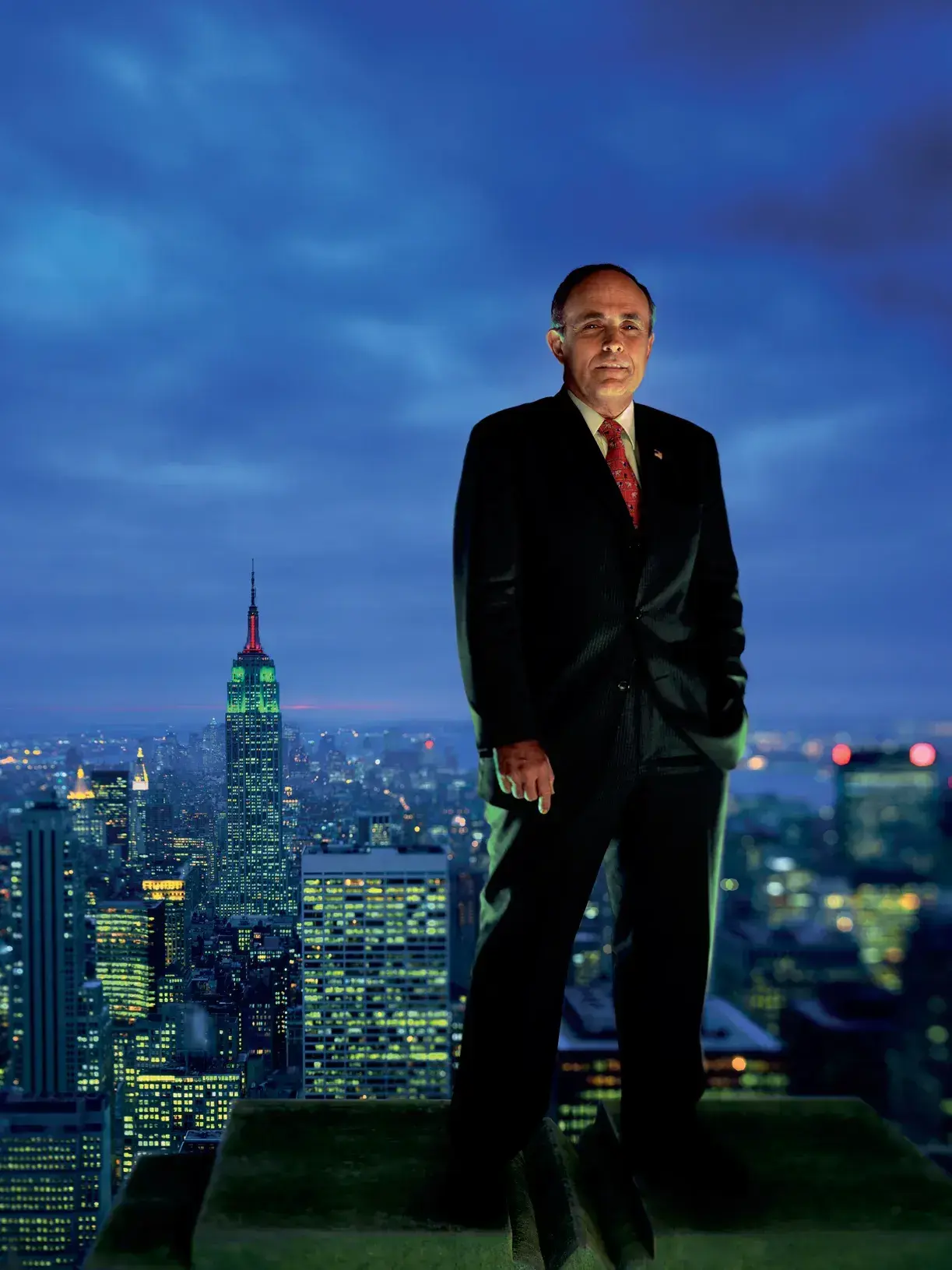
Accordingly, Heisler deliberately placed his primary light sources low and aimed them upward, mimicking the illumination of the city itself. He used Profoto Narrow Beam Reflectors and strip lights positioned directly on the platform beneath Giuliani’s feet as the main light sources. These lights were set on terraces two or three floors below and directed upward, creating the illusion that the mayor was being lit by the city.
Green gels were applied to all key light sources illuminating Giuliani. This green cast was chosen to harmonize with the cold, slightly greenish light emitted by fluorescent office lighting throughout the city.
Preserving this “noxious” green hue was a narrative decision, aligned with the anxious and somber post-9/11 mood. The chromatic shift functioned as an expressive psychological tool rather than a purely aesthetic choice.
As a counterpoint, a soft fill light with a warm orange gel was added from a higher position. This warmer element provided shadow detail and introduced a subtle suggestion of human warmth or resilience against the cold urban atmosphere.
Working with an important subject in an emotionally charged context, Heisler also had to ensure Giuliani’s physical comfort, especially given that the mayor himself “doesn’t like heights.”
Due to the danger and high winds at the 70th-floor level, and in order to ensure the subject’s safety, Heisler’s team constructed a special mock parapet. A large, solid wooden platform (12 by 12 feet) was built, positioned just one foot (about 30 cm) below where Giuliani would stand. This created a sense of security, allowing the mayor to relax without acute vertigo.
Despite the concerns of the crew and security personnel, Giuliani climbed onto the parapet “without a moment’s hesitation,” remarking, “Oh, this looks great,” much to the surprise of his protective detail.
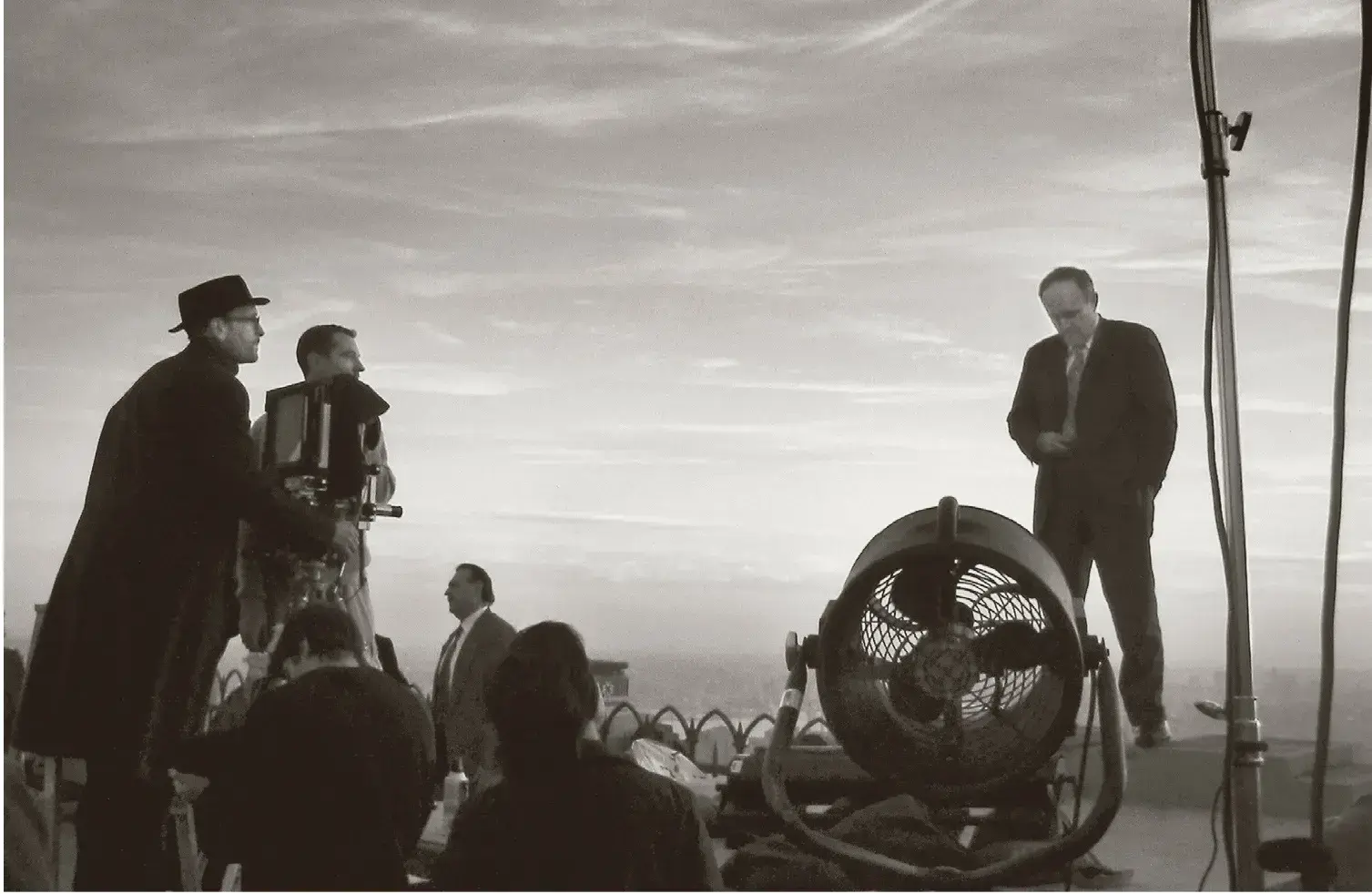
Because of an approaching storm front, strong winds, and rain (which eventually did begin to fall), Heisler also prepared an exact duplicate studio setup in an empty space below — the so-called Weather Room — as a contingency.
The portrait was published on the cover of Time magazine on December 31, 2001.
Heisler and his colleagues consciously chose a dark, contemplative dusk image for the cover. This was an unconventional decision, as magazine covers are typically bright and high-contrast to maximize visibility. The result was an image that, while technically complex, felt “theatrical” and “strangely elevated,” presenting Giuliani like Batman standing atop Gotham City.

Zheludkov Andrii
CEO at hand-made.world. In case of urgent questions or cooperation, please, drop me a line on [email protected]. I speak English, Ukrainian, Russian.
Comments