

Table of content
1. The eye of an artist, the mind of a scientist, and the heart of a journalist2. Ed Koch, 1989
3. The controversial Bush portrait, 1990
4. Rudolph Giuliani, 2001
5. Luis Sarria, 1987
6. Mick Jagger and Tina Turner, 1985
7. Michael Phelps, 2005
8. Jodie Foster, 1991
9. Senator John Glenn, 1998
10. George W. Bush, 1995
11. Bruce Springsteen, 2002
12. Denzel Washington
13. Mike Ditka and Ricky Williams, 2005
14. David Lynch, 1990
15. Hillary Clinton, 1992
16. The role of education and legacy
- November 20, 2025 at 9:58 PM
-
5.2K
-
1 comment
The intersection of art and politics: the controversial Bush portrait
The portrait of George H.W. Bush created by Gregory Heisler for the cover of Time magazine in 1990 remains arguably the most iconic and controversial work of his career. Selected for the Person of the Year issue, the image has become a textbook example of how an editorial concept, realized through complex in-camera technique, led to a serious political conflict and raised fundamental questions about journalistic ethics.
The session took place in late 1990, as Time was choosing its Person of the Year. The magazine’s editorial board viewed Bush’s presidency as deeply contradictory, and the portrait was meant to visually reflect that complexity.
On one hand, the President had achieved significant success in foreign policy, particularly through the “skillful coordination of a multinational coalition opposing Iraq’s invasion of Kuwait,” earning admiration both domestically and abroad. On the other hand, in Time’s assessment, his domestic policy was “hollow at the center” and lacked a coherent, substantive agenda.
Heisler’s goal was to create an image that would convey this duality, either literally or metaphorically. The portrait was intended as a visual analogue of a divided personality or inconsistent leadership. The editorial task was to transform a conventional portrait into a high-concept image that could articulate criticism visually while still acknowledging achievement.
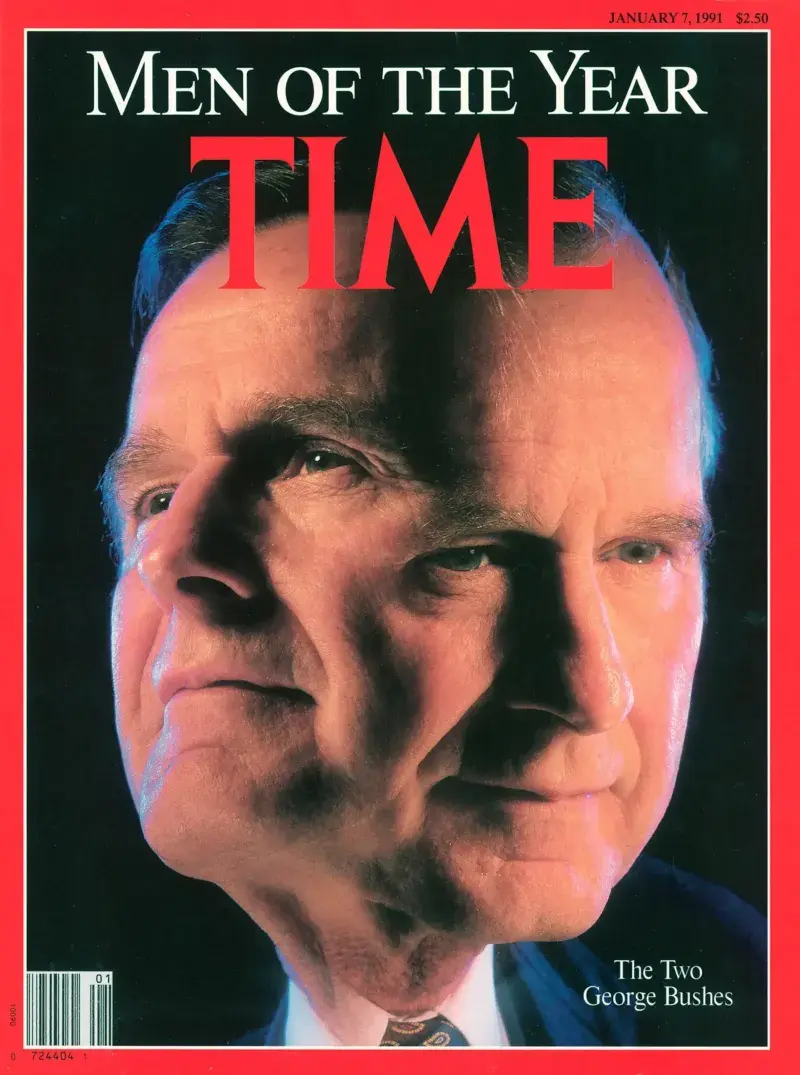
By that time, Heisler had already earned a reputation as a photographer capable of combining “the eye of an artist, the mind of a scientist, and the heart of a journalist,” and he was tasked with visualizing a complex editorial thesis.
Technical preparation: the studio as a laboratory of risk
Following his principle of pre-visualization and risk reduction, Heisler prepared the technical setup meticulously in his studio. He never approaches a shoot by “just winging it,” especially when working under intense pressure.
In-camera double exposure — To achieve the desired effect, Heisler employed deliberate in-camera double exposure. Unlike digital compositing, which was only beginning to emerge at the time, this technique produced the final image directly on a single sheet of film.
Metrological precision — Knowing that shooting time with the President would be strictly limited, Heisler turned the setup process into a scientific experiment.
Diagram creation — Heisler created a detailed diagram in advance, using a large sheet of seamless white paper on which all key points were marked.
Position marking — The diagram precisely indicated the positions of the tripod, light stands, and posing stool. The required height and intensity of each light source were also specified.
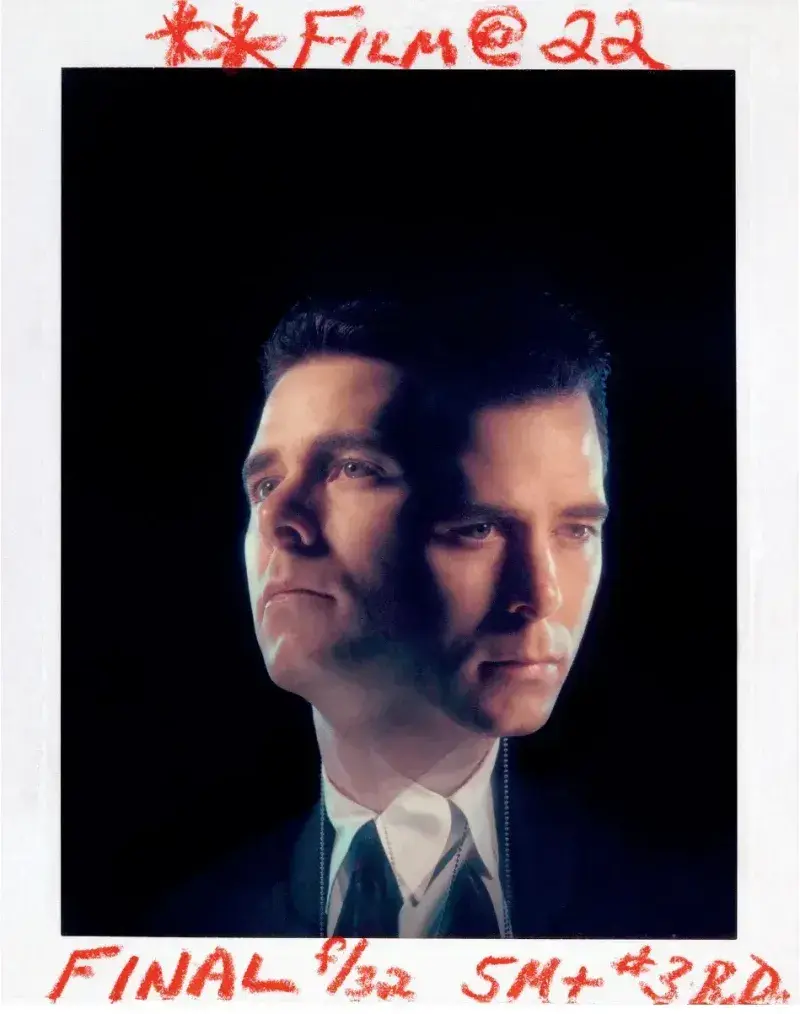
The shoot took place at the White House. The room allocated for the session was temporarily cleared of furniture to transform it into a studio.
Shooting mechanics — Once at the White House, Heisler laid his diagram on the floor to recreate the test setup exactly. The process was documented by Bush’s press secretary, Marlin Fitzwater, who later described it in his memoirs.
Posing process — The session itself was highly technical. President Bush was first photographed in profile, then asked to turn.
During the change of pose, the President had to remain at exactly the same height and angle as in the first position to ensure perfect alignment of the exposures.
Non-consensual technique — The most critical aspect was that President Bush was not informed that a double-exposure technique was being used.
Heisler worked with modern 4×5 large-format cameras using sheet film. These cameras allowed for precise, repeatable adjustments. To create the double-image effect, two cameras were positioned side by side.
Gregory Heisler is known for his mastery of light and his ability to convey the essence of a subject through innovative lighting techniques.
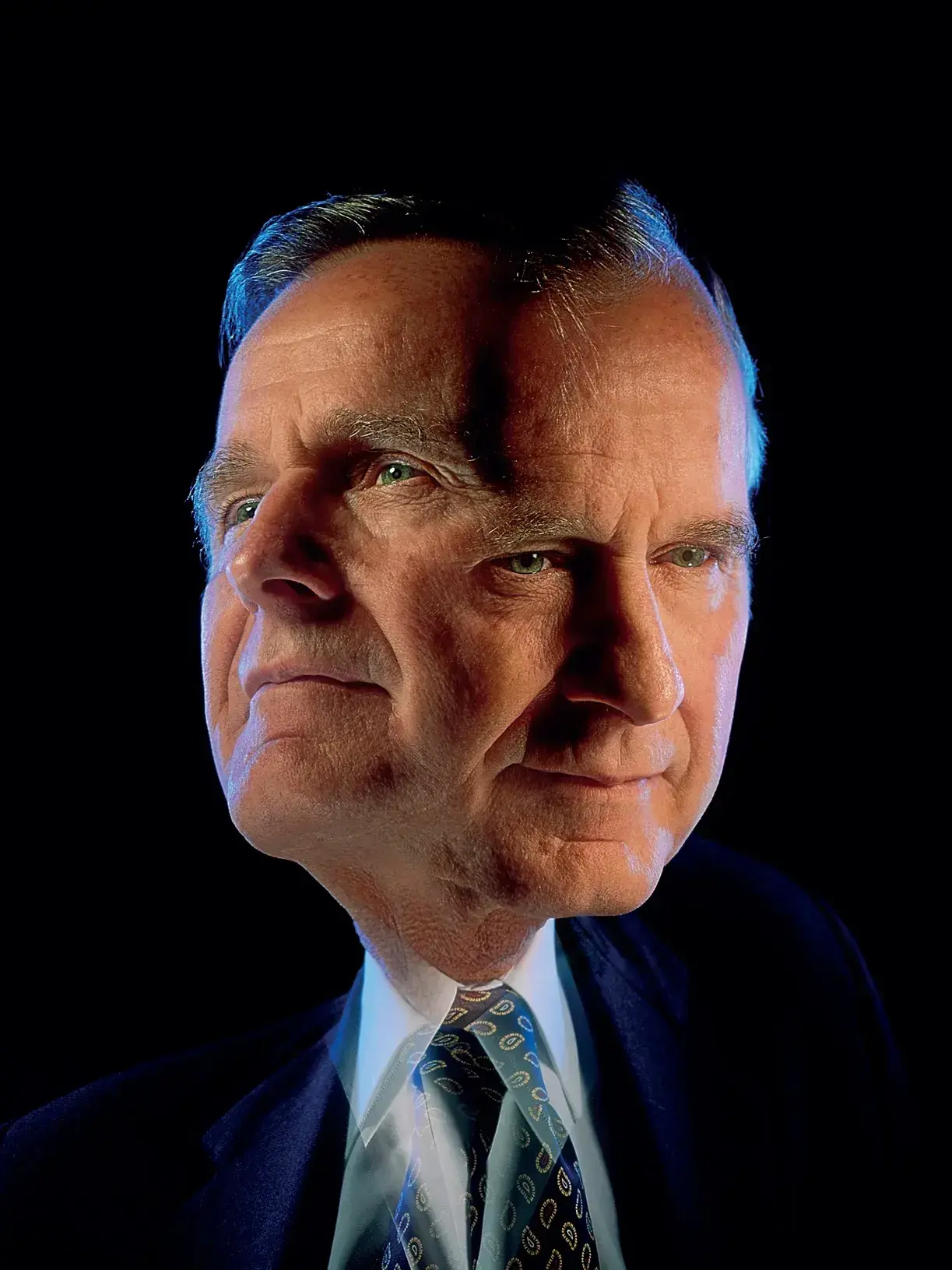
The Bush portrait required lighting to be matched with absolute precision so that the two exposures would align correctly. Highlights and shadows had to fall at exactly the right points in both images, mirrored to one another, allowing the two heads to merge seamlessly. This prevented issues such as an ear from one image overlapping the nose of the other.
The White House reaction and consequences for journalism
The result — a portrait with two faces — was immediately perceived by the White House as a direct, malicious insult, portraying the President as a “two-faced politician”.
In 1995, Bush’s press secretary Marlin Fitzwater gave an interview to Brian Lamb on C-SPAN, recounting the events from the White House perspective:
They wanted an interview with the President. They knew damn well that we would NEVER have granted an interview if we had known it was going to be a mocking cover portraying him as a two-faced politician — which is exactly what they had in mind. And I was genuinely outraged that we were tricked into granting an interview and allowing a photo session that was then used for that purpose.
They lied. They told me… They brought in a photographer from New York who was known for fashion and staged photography, but who was not a photojournalist.
Gregory Heisler — yes. And from early in the morning he had everything prepared. He marked the floor — where the camera should stand, where the President should stand… everything was diagrammed.
He kept moving the President literally an inch — this way, that way — changing lenses, moving him again. It went on and on. That’s not how photo sessions work for us. Normally everything is simple and fast.
Professional sanctions
As a result of the scandal, the White House privileges of both Heisler and TIME magazine were temporarily revoked.
The Bush Sr. incident became one of the most widely discussed cases in the history of photojournalistic ethics, illustrating the danger of a breach of trust that, in the White House’s view, had been used to introduce “non-consensual political criticism” into an image.
Nevertheless, Heisler was able to photograph President George W. Bush (the son of Bush Sr.) several years later. During that session, Bush Jr.’s PR manager issued an unambiguous warning to Heisler: “I don’t want any of that lying bullshit like you did with his father.”

Zheludkov Andrii
CEO at hand-made.world. In case of urgent questions or cooperation, please, drop me a line on [email protected]. I speak English, Ukrainian, Russian.
Comments